
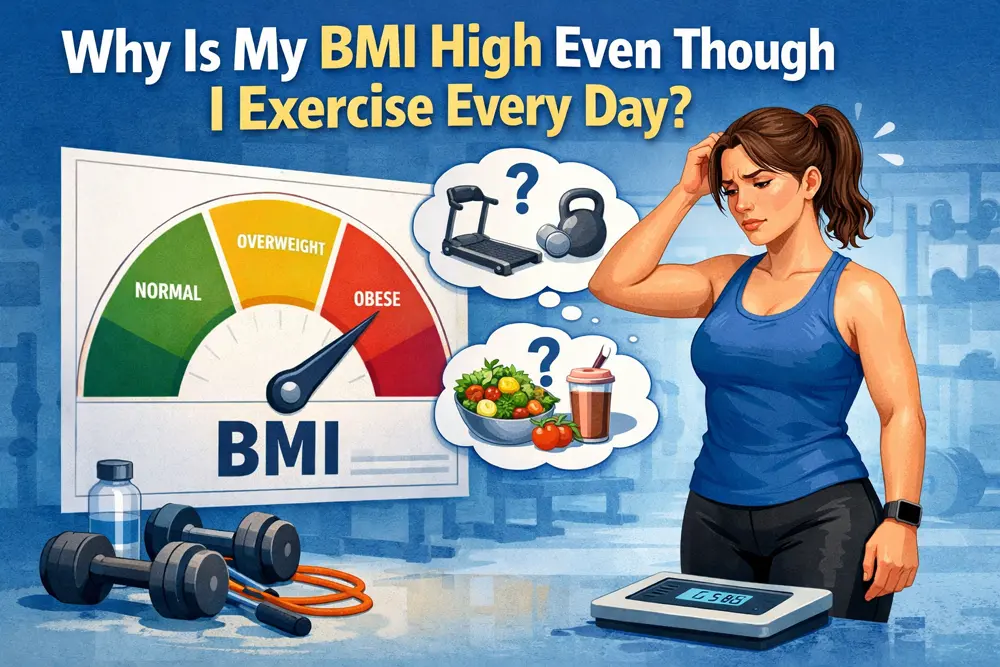
If you exercise every day and still see a high BMI, it can feel unfair and confusing. You wake up early, stay consistent, push through workouts, and try to do everything “right,” yet the number refuses to cooperate. Over time, this can quietly damage motivation. You may start questioning your effort, your routine, or even your body. Many people assume that daily exercise should automatically reduce weight and improve BMI, but real bodies do not always follow simple formulas. The truth is that BMI is a limited measurement, and daily exercise changes your body in ways it cannot capture. Understanding this gap can help you stop blaming yourself, reduce anxiety around numbers, and focus on progress that actually matters for your health and long-term well-being.
Who This Article Is For
This article is for people who exercise regularly but feel stuck or discouraged by their BMI results. It is especially relevant if you work out daily, follow a fitness routine, or have recently become more active yet still fall into the “overweight” or “high BMI” range.
It is also for anyone who feels physically stronger, fitter, or more energetic but feels confused when numbers do not reflect those improvements. If you want a calm, realistic explanation instead of guilt or fear, this article is meant for you.
Quick Summary
Your BMI can be high even if you exercise daily because BMI only measures height and weight. It does not distinguish between fat and muscle, ignores bone density, and cannot measure fitness or health improvements. Regular exercise often increases muscle mass and water retention, which can keep weight and BMI high even as your body becomes healthier and stronger.
Why This Problem Happens
BMI was created as a simple mathematical tool, not as a complete health assessment. It works reasonably well for large populations, but it performs poorly at the individual level, especially for active people.
When you exercise daily, your body adapts in ways that BMI cannot track. Muscles grow denser, bones may strengthen, and hydration levels shift. These are all positive changes, yet BMI treats them the same as body fat.
The problem arises when BMI is treated as a final judgment of health rather than a rough reference point. This misunderstanding creates frustration, even when the body is clearly improving.
Detailed Explanation
Several factors explain why daily exercise does not always lower BMI.
- Muscle weighs more than fat
Strength training and regular movement increase muscle mass. Muscle is compact and heavy, which can raise body weight even while fat decreases. - BMI does not measure body composition
Two people with the same BMI can look completely different because BMI cannot see fat percentage or muscle mass. - Fat loss may not change scale weight
Fat occupies more space than muscle. Losing fat and gaining muscle can change your shape without changing your weight. - Water retention from exercise
Muscles retain water during recovery and repair, temporarily increasing weight. - Calorie balance still matters
Exercising daily does not guarantee weight loss if food intake matches energy use. - Body structure and genetics
Bone density, frame size, and genetics influence weight independently of fitness.
An often-overlooked insight is that exercise improves internal health first. Blood markers, insulin sensitivity, strength, and endurance usually improve long before visible weight changes occur.
Real-Life / Practical Example
Consider someone who starts exercising daily after years of minimal activity. They begin walking, lifting weights, and doing basic workouts.
After a few weeks, they notice better sleep and more energy. By the second month, daily tasks feel easier, and their posture improves.
When they step on the scale, however, the number barely moves. Their BMI still reads high, and they feel disappointed.
What is happening is body recomposition. Fat is slowly decreasing, muscle is increasing, and the scale is caught in the middle. Health is improving, but BMI cannot see it.
Clarification or Comparison
BMI only compares height and weight. It assumes all weight is the same.
Body fat percentage separates fat from lean tissue, giving a clearer picture of composition.
Physical capability reflects how strong, flexible, and energetic your body is.
A person can have a high BMI and excellent health markers, while another person with a normal BMI may struggle with stamina, strength, or metabolic health.
Why This Topic Confuses Most People
This topic is confusing because BMI is easy to calculate and widely discussed, making it feel authoritative. Numbers feel objective, even when they are incomplete.
Another source of confusion is expectation. Many people believe exercise automatically equals weight loss. When that does not happen, they assume something is wrong.
Social comparison adds pressure. Seeing others lose weight quickly can make slow or invisible progress feel like failure, even when it is healthy and sustainable.
Common Mistakes People Make
Misunderstanding BMI often leads to harmful behaviors.
- Judging health solely by BMI
- Ignoring strength, endurance, and energy gains
- Over-restricting food despite heavy training
- Stopping exercise due to lack of scale progress
- Comparing results with people who have different body types
These mistakes can lead to burnout, frustration, and unhealthy cycles.
Important Things Most People Ignore
Many people ignore non-scale improvements. Better sleep, reduced stress, improved mood, and increased confidence are real health gains.
Another overlooked factor is long-term risk reduction. Regular exercise lowers the risk of many chronic conditions regardless of BMI.
People also ignore that weight loss is not the primary benefit of exercise. Strength, balance, and functional ability become increasingly important with age.
Frequently Asked Questions
Is a high BMI always unhealthy?
No. A high BMI does not automatically indicate poor health, especially in physically active individuals.
Can daily exercise increase BMI?
Yes. Muscle gain and temporary water retention can increase body weight and BMI.
Should I stop exercising if my BMI stays high?
No. Exercise improves health even when BMI does not change. Stopping removes those benefits.
What should I track besides BMI?
Track strength, stamina, waist measurement, mobility, and how you feel daily.
Why does my BMI not change after months of workouts?
Your body may be replacing fat with muscle, keeping weight stable while health improves.
What You Should Do Next
Shift focus from a single number to overall progress. Notice improvements in strength, energy, sleep, and daily function.
Use BMI as a rough reference, not a verdict. Combine it with other indicators to get a fuller picture of health.
Stay consistent. Meaningful health changes often happen quietly before they become visible.
Final Thoughts
A high BMI does not cancel out the benefits of daily exercise. Your body responds to movement in complex ways that no simple formula can capture. If you are exercising consistently, feeling stronger, and living more actively, you are improving your health, even if BMI does not reflect it. Progress is real, even when the number stays the same.
Last updated: February 2026